
Mon - Fri: 8:30am - 5:30pm, closed Wednesday

21902 W. Devonshire St, CA 91311


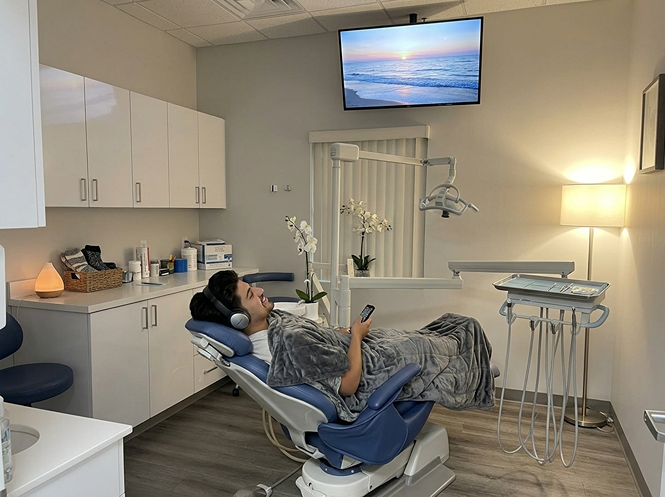
You’ve been avoiding it for months. Perhaps years. You know you have to go, but every time you think about making that appointment, you get a little uncomfortable. You’re not alone, and really, there’s nothing to be ashamed of.
Dental anxiety is very common. More than 60% of patients report some level of dental fear, and some 40% said they’d be interested in sedation if it were an option, according to a 2024-2025 American Dental Association consumer survey. That is not a small number. That’s almost half of all patients.
And here’s where it gets more complicated as a parent: your anxiety can be passed silently to your children. Your child picks up on your tension when she hears the word “dentist.” So finding a dental office that really takes anxiety seriously and has real solutions for it matters a lot more than most people realize.
This post is about that. If you’re in the Chatsworth area and you’ve been putting off the dentist because of fear, let’s talk through your real options.
The thing about dental anxiety is it's not just uncomfortable for appointments. It makes people avoid care at all, sometimes for years. And when it does, little things turn into big things.
A cavity that would have been a quick filling is now a root canal. A perfectly treatable gum problem turns into a need for surgery. The fear of the dentist actually produces the exact outcome that people were afraid of in the first place.
Inhalational sedation, specifically nitrous oxide, was found to significantly reduce dental anxiety scores compared to behavioral approaches alone (Research in Evidence-Based Dentistry, 2025). That’s not just a comfort thing; it’s a clinically effective way to really break the anxiety cycle.
The good news is that dental sedation has come a long way . That doesn't mean you're "out cold" or that something scary is happening. It simply means your dentist has safe, controlled ways to help your body and mind relax enough to get the care you need.
Here's a plain-English breakdown of what's available and who each option tends to work best for.
This is the most common and one of the safest types of sedation available. You breathe it in through a small nose mask. It takes effect in a few minutes and disappears just as quickly when the mask is removed.
Nitrous oxide won’t put you to sleep. You're awake, you can still answer your dentist, and you just feel... calm and floaty. Things are okay, and it's not that big of a deal, which is kind of the point.
Best for: Mild to moderate anxiety, nervous but cooperative kids, and patients who are driving themselves home after the appointment.
What it’s NOT: It’s not deep sedation. If your anxiety is severe or you have a lot of dental work to do at one time, you may want something a little stronger.
This one involves you taking a prescription pill, generally an hour before your appointment. You sit back in the chair, and you feel relaxed and a little sleepy, and most patients say they hardly remember the appointment afterwards.
You are not unconscious, but you are in a very relaxed state. Your dentist is still able to talk to you and check on you during the procedure.
Best for: Moderate to severe anxiety, patients with a strong gag reflex, or anyone who needs a longer or more complex procedure and wants to be calm for the whole thing.
Important: You will need a driver to take you home after oral sedation. Plan for that beforehand.
This is a step forward in depth. The IV delivers the sedative directly into your bloodstream, so it works faster and can be adjusted during the procedure. Many patients remember little or nothing of the appointment.
You are still breathing on your own, and your protective reflexes are still working, but you are in an extremely relaxed state where even complicated procedures seem to have taken only minutes.
Best for: Extreme dental anxiety, patients who need a lot of work done (multiple extractions, implant placement, etc.), people who’ve had traumatic dental experiences in the past.
Sometimes, no sedation is needed at all. Often, the real cause of dental fear is not pain itself but the anticipation of pain. When a local anesthetic is given slowly and with the appropriate topical numbing agent first, the whole experience is different.
At Angel Smile Dental Group, local anesthesia is not just about numbing the pain. The delivery is part of a larger approach to making you comfortable: warm conversation, clear communication about what’s coming next, and a no-rush pace.
Best for: Patients with mild anxiety who are mainly afraid of the pain rather than the dental setting. Also great for kids on their first real procedure.
If you're a parent bringing in an anxious child, it's a little bit different. Pediatric dentists use a technique called Tell-Show-Do. They tell the child what they are going to do, then they show the child the tool without putting any pressure on them, and then they do the procedure. This is often used in combination with nitrous oxide for children who need a little extra help to relax.
The aim is not to trick your child or to rush through the visit. It is to help them develop a positive attitude to dental care that will last a lifetime.
Best for: Kids 3 and up with dental anxiety, kids who have had a bad experience before, or kids who are just very sensitive to new environments.
“Can I sedate my kids?” is a question many families ask. A perfectly fair question. Here’s what the research says: Nitrous oxide has one of the best safety records of any sedative used medically in children. It has been used in pediatric dentistry for decades, has no known long-term effects, and is eliminated from the body within minutes of stopping the flow.
Oral sedation is used more judiciously in children and is always followed by a complete health history review. Your dentist will ask about your child’s weight, any medications he or she takes, and any allergies. Don't skip the health forms, because that conversation matters.
Bottom line: Sedation is not something to be afraid of. It’s something that makes dental care accessible for people who really struggle otherwise.”
Sedation dentistry is booming. The surveys from 2025 indicate that 42% of the patients are interested in sedation during dental treatment. With patient demand for sedation training real and growing, more dental offices are investing.
And there’s a growing consciousness of the effect of untreated dental anxiety on general health. When people delay visiting the dentist long enough, they're not just risking their teeth. They’re exploring potential connections to heart disease, diabetes complications, and chronic infections. Access to dental care, including sedation, is increasingly seen as a public health issue, not just a matter of patient comfort.
For families especially, catching anxiety early—whether it’s in kids or parents—and working with the right tools leads to better long-term outcomes for everyone.
Yes, when done by a trained and experienced dental team. Nitrous oxide, in particular, has been used on children for decades and has an excellent pediatric safety record. Before recommending any type of sedation, your dentist will review your child’s health history.
It depends on what kind. Nitrous oxide and oral sedation allow you to be alert but relaxed. IV sedation is a deeper level of sedation where many patients have little memory of the procedure, but they are still breathing on their own. General anesthesia (full unconsciousness) is usually used in hospital settings or for very specific cases.
Some plans will cover sedation for medical reasons, such as patients with severe anxiety, special needs, or complex procedures. You should ask your insurance company about that. The staff at Angel Smile Dental Group can also help you understand your options before your appointment.
That is exactly the kind of discussion you would have at a consultation. Your dentist will want to know your anxiety level, medical history, what kind of procedure you need, and your preferences. That first conversation is so important because there’s no one-size-fits-all answer.
If you or your kids have been avoiding the care you need because of dental anxiety, sedation dentistry is a real, safe, and accessible solution. This is not drama. This is not a last resort. This is not a sign that there is something wrong with you. It simply means you need a little support to feel at ease, and that's fine.
Every day we see anxious adult and young patients at Angel Smile Dental Group in Chatsworth. It’s not to throw you through something frightening. It’s about making dental care feel doable, so you keep coming back, and your family stays healthy.
So, are you ready to jump? Call Angel Smile Dental Group or book your appointment online today. Say that you're nervous. I mean, seriously, just say it. From there, they will work with you.


