
Mon - Fri: 8:30am - 5:30pm, closed Wednesday

21902 W. Devonshire St, CA 91311


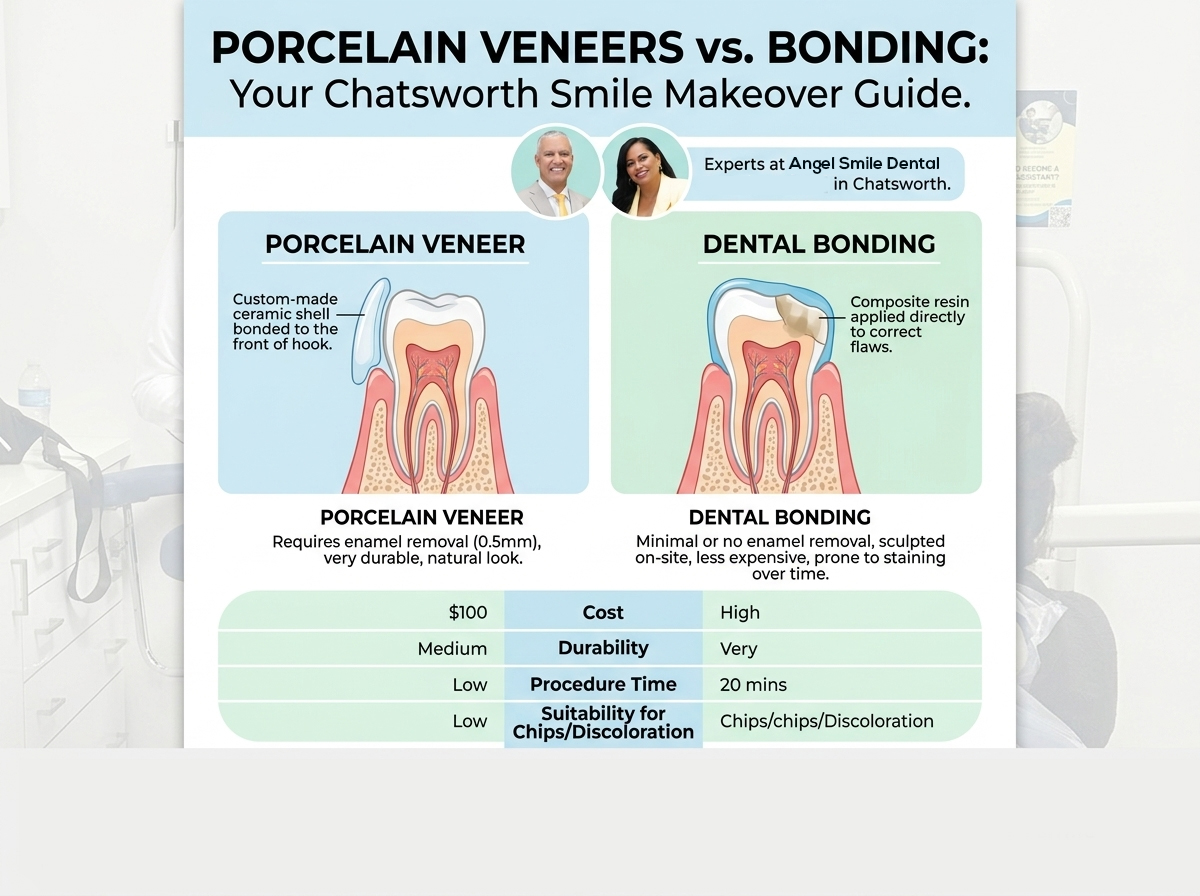
You want a better smile. It’s easy enough. But then someone mentions veneers, and someone else says bonding, and suddenly you’re sitting at your kitchen table in Chatsworth trying to figure out what either of those means in your real life, your real schedule, and your real budget.
This post will explain everything in simple language. An honest comparison you need before booking a consultation.
This is what most people go through. You search for how to fix my smile, and you get a wall of dental jargon. Words such as “composite resin,” “enamel preparation,” and “smile design consultation” are more like a chemistry class than a conversation you can have with your dentist.
And if you’re a parent in Chatsworth juggling school pickups, work, and everything in between, you don’t have time to sift through ten different confusing articles before your next appointment.
So let’s fix that.
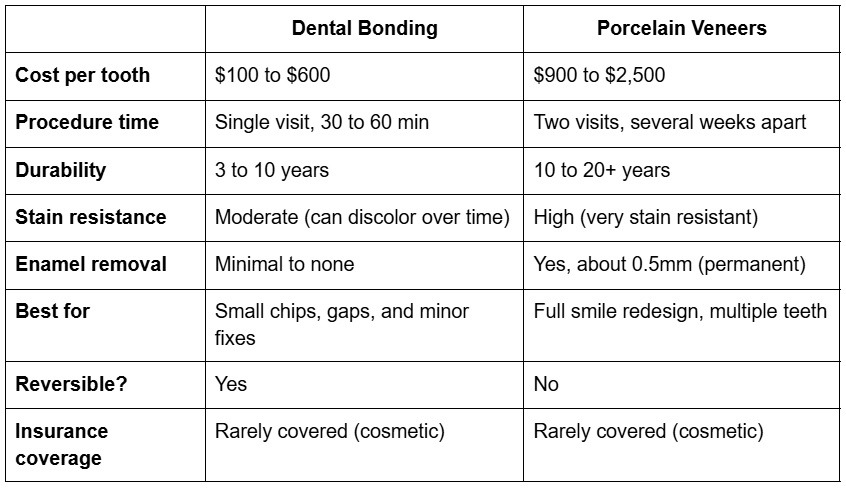
One of the easiest cosmetic dentistry procedures in Chatsworth that you can have done is dental bonding. Your dentist puts a tooth-colored resin directly on your tooth, sculpts it by hand, and then hardens it with a special light. It takes approximately 30-60 minutes per tooth from start to finish, and you walk out the same day with results you can see.
It works great for:
Another big draw is the cost. Dental bonding costs between $100 and $600 per tooth, making it one of the most affordable cosmetic procedures. For a parent who wants to see improvement quickly without a huge financial commitment, bonding can be a smart place to start.
The tradeoff is longevity. Bonding lasts 3 to 10 years, depending on your habits. It is more likely to get stains from coffee, tea, and red wine as time goes by. And it'll chip if you're not careful.
Porcelain veneers are thin shells that are fabricated to your specifications in a dental laboratory and bonded to the front surfaces of your teeth. They're surprisingly natural-looking because porcelain is a close imitation of how real enamel lets light pass through. That is something composite resin cannot completely duplicate.
Getting veneers is at least a two-visit process. At the first appointment, impressions of your teeth are taken, and a small amount of enamel (around 0.5 millimeters) is removed. The second visit is when the veneers that are finished are placed permanently.
What matters is the word “permanently.” Veneers are a lifelong commitment because enamel does not grow back. You begin this process, and you are not going back to your natural teeth. That is not a reason to avoid them, but it is something you should completely understand up front.
Veneers work well for:
You can see the cost in all that custom work. 2025 data shows that porcelain veneers cost between $900 and $2,500 per tooth. A full set of veneers (six to eight) averages about $15,000 across the country. That is an investment, and it is an investment that takes some serious thought.
And that’s where the “lifestyle” comes in. Chatsworth is an active, family-friendly community. People here are active, social, and practical. Here’s how to think about which option is right for you.
Bonding might be the best option if:
Veneers might be the better fit if:
In fact, a number of our patients at the Chatsworth office do both; they have veneers put on the teeth that show the most and bonding on teeth that are less visible. A good cosmetic dentist will walk you through what makes sense for your particular situation.
Porcelain veneers have a flexural strength of 100 to 150 MPa, which is far more durable than composite resin alternatives. This is confirmed by a 2025 industry overview. Bonding is good for small repairs, but it tends to wear and stain more, especially for patients who drink coffee or tea regularly.
The American Academy of Cosmetic Dentistry (AACD) reports that nearly 92 percent of adults believe an attractive smile is a very important social asset. A survey conducted in 2024 revealed that about 48% of American adults are unhappy with their smiles. Discoloration and misalignment are the two most common complaints. Bonding and veneers both solve those problems, but the best answer is completely based on how much change you are looking for.
Cosmetic dentistry is growing very rapidly. Analysts say the global market for cosmetic dentistry will exceed $32 billion by 2026, driven by growing consumer awareness and more financing options. “People are returning to work and social activities, and they want to feel good about their appearance,” said a Chatsworth resident. “We’re seeing a local rise in demand for cosmetic dentistry.
Minimally invasive cosmetic procedures such as bonding and no-prep or minimal-prep veneers are gaining popularity because they produce visible results without requiring extended treatment time. If you are interested in newer veneer options that involve less enamel removal, that would be a great conversation to have in a consultation.
Both can look very natural when performed by an experienced cosmetic dentist. That said, porcelain veneers have an advantage in that the material more closely mimics the way real enamel reflects light. Bonding looks good immediately after treatment, but can yellow or stain over time. If you are comparing the two on appearance alone in the long term, veneers win in that department.
Bonding is usually painless and rarely requires anesthesia. Veneers require a small amount of enamel to be removed, so your dentist will use a local anesthetic to keep you comfortable. Most patients say it is no worse than getting a filling. After placement of the veneers, you may have some sensitivity. This is normal and should resolve in a few days.
Veneers and bruxism (teeth grinding) do not mix well. Grinding adds extra stress to the porcelain and can reduce its life substantially. If you grind, your dentist will probably tell you to wear a night guard to protect your investment. Grinding also threatens bonding. Neither of these options is optimal without first addressing the underlying habit.
Not really. Bonding and veneers are considered elective cosmetic procedures and are typically not covered by insurance companies. The exception is bonding to repair a structurally damaged tooth, which may be partially covered. The good news is that many dental offices (ours included) offer flexible payment plans and financing to help make treatment more manageable.
The truth about porcelain veneers vs. dental bonding is that one isn't better than the other. The right choice depends on your teeth, your goals, your schedule, and yes, your wallet.
The most important thing is that you walk into your consultation informed. You know the basics. You know what bonding can and can’t. You know the price of veneers and why they last longer. You know what questions to ask.
The next step is easy. Just come in and talk to us. At Angel Smile Dental Group, Chatsworth, we take the time to understand what you really want before we recommend anything. There’s no pressure, no hurry, no script.


