
Mon - Fri: 8:30am - 5:30pm, closed Wednesday

21902 W. Devonshire St, CA 91311


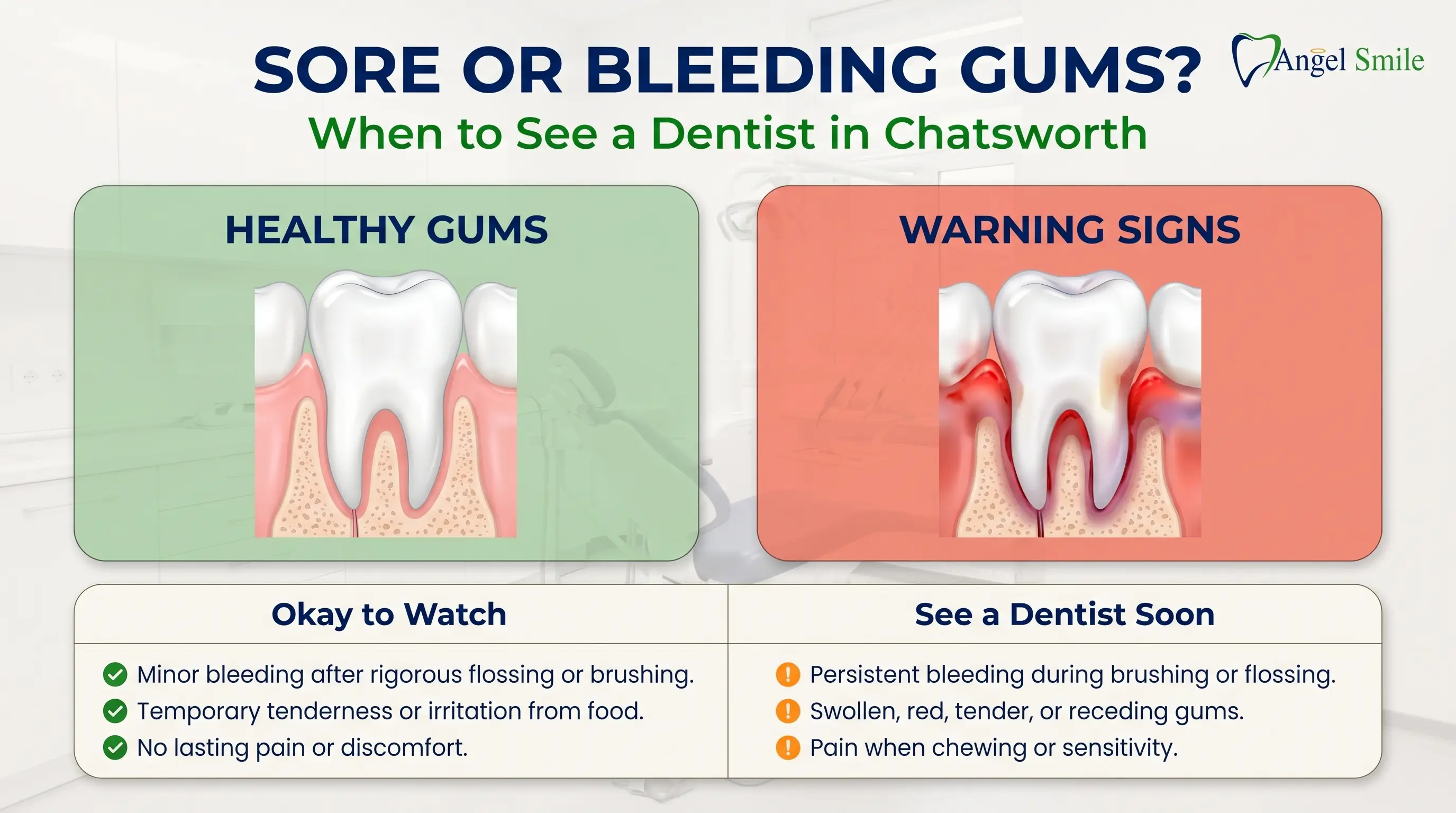
Here is the short answer. Knowing when to see a dentist for gum pain comes down to a few clear signs: pain that lasts more than three days, gums that bleed every time you brush, or swelling, pus, a bad taste, or a loose tooth. Those signs point to gum disease that will not heal on its own. Mild tenderness after a rough flossing day can wait a few days. Pain with swelling or bleeding should not. When gum pain sticks around, your body is asking for help, and the fix is almost always easier and cheaper when you act early.
Gum problems are far more common than most people think. The CDC reports that about 42 percent of adults age 30 and older already have periodontitis, a serious form of gum disease. So if your gums hurt, you are not alone, and you are not being dramatic by getting it checked.
Your gums are the seal that protects the roots of your teeth and the bone underneath. When that seal gets irritated, it swells, turns red, and bleeds. Dentists call the early stage gingivitis. It is caused by plaque, a sticky film of bacteria that builds up along the gumline when brushing and flossing miss a few spots.
Gingivitis is reversible. That is the good news. Catch it early and a professional cleaning plus better home care can turn it around in a couple of weeks. Ignore it, and it can slide into periodontitis, where the gums pull away from the teeth and the bone starts to shrink. That stage is manageable but not fully reversible, so timing matters a lot.
Sore gums are not always about disease, though. A popcorn kernel stuck below the gumline, a night of aggressive brushing, a new whitening product, or hormonal changes during pregnancy can all make gums tender for a short while. The trick is knowing which kind of pain you have.
Use this simple guide. It reflects what we watch for with patients every week at our Chatsworth office.
Usually okay to watch for 2 to 3 days:
See a dentist soon if you notice:
Fever, facial swelling, or a throbbing that keeps you up at night is not a "watch it" situation. That can signal an infection spreading, and you want to be seen the same day. Our guide on managing dental pain until you can see an emergency dentist walks through what to do while you arrange a visit.
Pro tip: Try the three-day rule. If a gum symptom has not clearly improved after three days of gentle brushing, daily flossing, and warm salt-water rinses, book a visit. Gums that are healing get better each day. Gums that are infected do not.
Bleeding is the symptom people brush off the most, and it is the one you should trust the least. Healthy gums do not bleed during normal brushing. When they do, it usually means plaque has been sitting along the gumline long enough to cause inflammation.
People often react by brushing that spot less because it hurts. That makes it worse, because the plaque keeps building. The better move is gentle, consistent cleaning with a soft brush, plus flossing that reaches just under the gumline. If you use an electric brush, our post on how to use an electric toothbrush the right way shows the technique that actually removes plaque without hurting your gums.
A quick real-world example. A Canoga Park mom came in sure she needed deep gum surgery because her gums bled daily. Her real problem was a rushed 30-second brushing routine and no flossing. One cleaning, a technique fix, and two weeks later the bleeding stopped completely. Not every case is that simple, but many are, which is exactly why an early visit pays off.
Gum disease is quiet, and that is the danger. It rarely hurts a lot until it is advanced, so people wait. The National Institute of Dental and Craniofacial Research notes that periodontal disease becomes more common with age, and it is a leading reason adults lose teeth.
Waiting also costs more. A routine cleaning and a checkup is a small, predictable expense. Letting gingivitis grow into periodontitis can lead to deep cleanings, gum treatment, and in serious cases tooth replacement that runs into the thousands. From our experience working with families across the San Fernando Valley, the patients who come in at the first sign of bleeding almost always have the easiest, cheapest path back to healthy gums.
There is a whole-body angle too. Gum disease is linked to diabetes, and the link runs both ways: high blood sugar makes gums worse, and infected gums make blood sugar harder to control. The CDC lists diabetes and smoking as major risk factors for serious gum disease. If diabetes runs in your family, sore gums deserve extra attention, not less.
You can ease mild gum pain while you wait for an appointment. None of this replaces a dentist, but it helps.
Building a solid daily habit prevents most gum trouble in the first place. Our team's daily dental care routine is a good place to start, and regular visits keep small problems small. Here is why regular check-ups matter more than most people realize.
Worried the visit itself will hurt? That fear keeps a lot of people away, and it should not. A gum checkup is gentle. Your dentist looks at your gums, measures the small spaces around each tooth, and often takes an x-ray to check the bone. Most cases start with a professional cleaning to remove the plaque and tartar your brush cannot reach.
If you get nervous at the dentist, tell us. We help anxious patients every day, and there are calm, judgment-free ways to get you through it. You can read how our Chatsworth office helps patients with dental anxiety so you know what support is available before you even walk in.
Not sure whether your symptom counts as an emergency? Our emergency dental page explains when to call right away, and the 7 signs it is time to visit a dentist post covers the broader warning signs worth knowing.
Some gum symptoms are easy to shrug off. These five are worth taking seriously, because each one is a common early sign of gum disease that a dentist can treat quickly.
Notice any two of these together and it is time to book. You do not need to wait for the pain to get worse. The sooner a dentist sees these signs, the simpler the treatment, and the better your odds of keeping every tooth right where it belongs.
More than three days is your signal to book a visit. Gum pain that lasts beyond a few days, or that comes with bleeding, swelling, or a bad taste, points to inflammation that needs professional care. Short-lived tenderness after flossing hard or eating something sharp usually settles on its own.
Early bleeding from gingivitis can improve with better brushing, daily flossing, and salt-water rinses, and a professional cleaning speeds it up a lot. If the bleeding keeps happening for more than a week despite good home care, see a dentist, because it likely means plaque and tartar have built up below the gumline where a brush cannot reach.
Most gum pain is not an emergency, but some cases are. Get seen the same day if you have facial swelling, a fever, pus, or a tooth that suddenly feels loose. Those signs can mean an infection that needs prompt treatment. Mild soreness without those signs can wait for a regular appointment.
Sore gums without bleeding can come from a canker sore, a popcorn hull or food stuck below the gumline, brushing too hard, grinding your teeth, or a new dental product. If the soreness lingers past a few days or you feel a bump, have it checked so a small issue does not grow into a bigger one.
Your gums are trying to tell you something, and the message is simple: catch it early. Knowing when to see a dentist for gum pain saves you money, protects your teeth, and often takes just one gentle visit to fix. If your gums have been sore, swollen, or bleeding for more than a few days, that is your cue. Our friendly, bilingual team in Chatsworth is happy to take a look and get you comfortable again.


