
Mon - Fri: 8:30am - 5:30pm, closed Wednesday

21902 W. Devonshire St, CA 91311


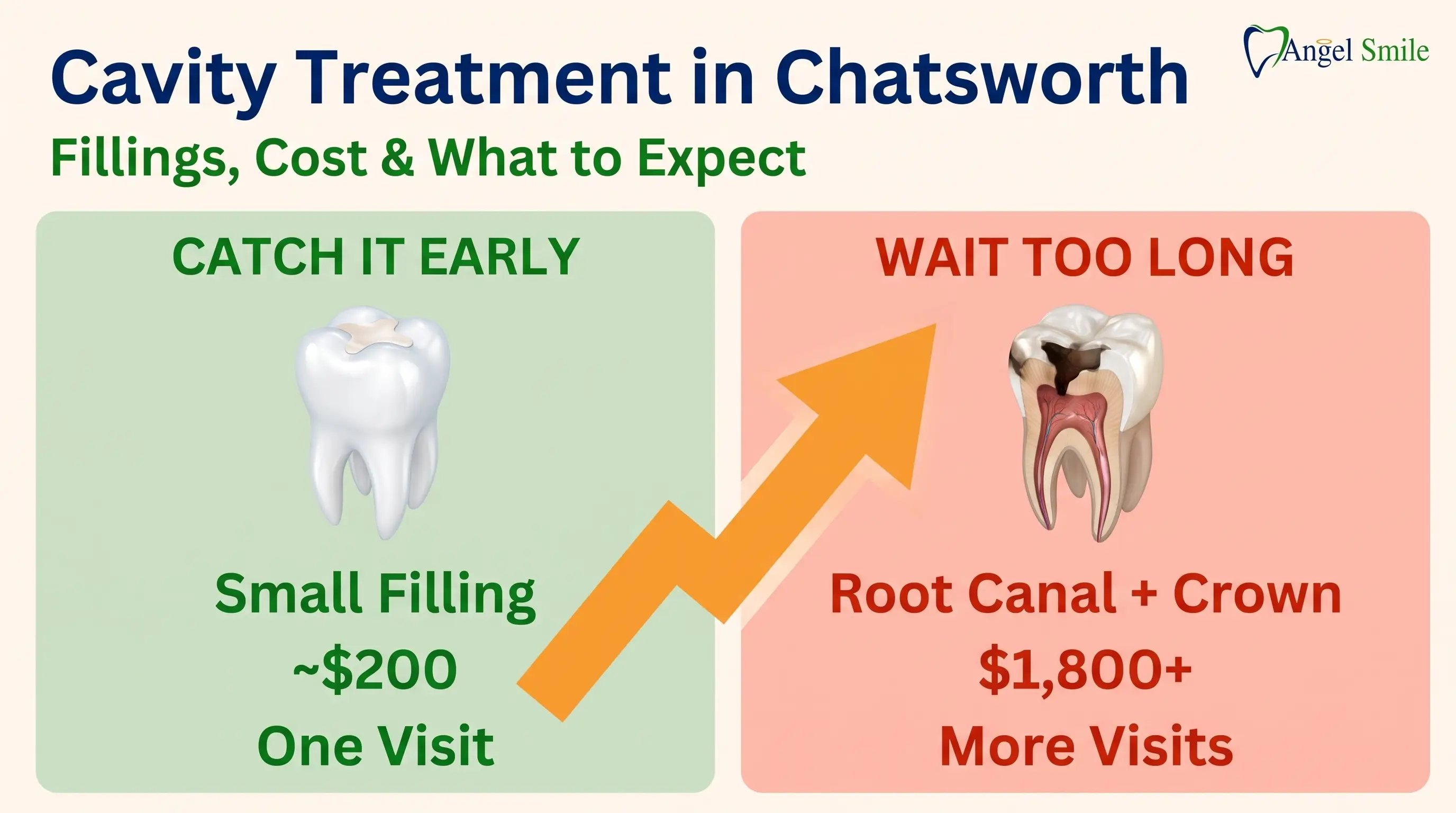
Cavity treatment in Chatsworth usually means one quick visit and a tooth-colored filling, and the sooner you come in, the smaller and cheaper the fix. A small cavity caught early is often a $150 to $300 filling finished in under an hour. Wait too long and that same tooth can need a root canal and a crown that runs past $1,800. About 1 in 4 adults aged 20 to 64 have an untreated cavity right now, according to the Centers for Disease Control and Prevention, so if you think you have one, you are far from alone, and you are in the right place. This guide walks you through exactly what cavity treatment at a Chatsworth dental office looks like, what it costs, how fast you can be seen, and how to keep a tiny spot from turning into a big bill.
You will know what to expect before you ever sit in the chair, from the numbing to the drill-free options to the way we handle insurance and payment for families across the San Fernando Valley.
Cavity treatment in Chatsworth depends on one thing above all: how deep the decay has gone. A cavity is a hole in the tooth caused by acid from plaque bacteria, and it only grows. The earlier you catch it, the simpler and gentler the repair. Here is how the treatment scales with the size of the problem.
For a small to medium cavity, you get a filling. This is by far the most common fix, and it is the one most people picture. We remove the decayed part of the tooth and fill the space with a tooth-colored composite that blends in so well that nobody can tell it is there.
A typical filling visit at our Chatsworth office runs like this:
Most single fillings are done in 30 to 60 minutes, and you can eat once the numbness wears off. If you have been putting this off because you dread the drill, ask us about our approach to helping nervous patients feel calm during the visit.
For a larger cavity, you may need an inlay, onlay, or crown. When decay takes out too much of the tooth for a simple filling to hold, we rebuild the chewing surface with a custom-made piece. A crown caps the whole tooth and protects what is left. You can read more about when a crown is the right call if your dentist has mentioned one.
For a deep cavity that reached the nerve, you may need a root canal. Once decay hits the soft center of the tooth, it can cause an infection, and that is when a tooth starts to throb. A root canal clears the infection and saves the tooth, and it is a lot more comfortable than its reputation. Our plain-language root canal guide breaks down the whole process with no fear tactics.
For a tooth too far gone to save, an extraction may be the kindest option. This is the outcome we work hardest to avoid, and it is exactly why catching decay early matters so much. The good news is that if you notice the early signs of a cavity and come in, you almost never get here.
Pro tip: If a tooth is sensitive to cold or sweet but does not hurt on its own yet, that is usually the filling stage, the cheapest and fastest stage to treat. The window between "a little sensitive" and "throbbing at 2 a.m." is your money-saving window. Book while it is still just sensitive.
Cavity treatment cost in Chatsworth depends on the size of the cavity, the material, and your insurance, but here are honest ballpark ranges so nothing surprises you at the front desk. A tooth-colored filling generally runs about $150 to $450 per tooth, with small single-surface fillings at the low end and larger multi-surface ones higher. Cost data compiled from the American Dental Association's fee surveys puts composite fillings in that same range nationally, and our Valley pricing sits right in line.
Here is roughly how the numbers climb as decay gets deeper, which is the whole argument for coming in early:
The pattern is hard to miss. The same tooth costs a couple hundred dollars today or several thousand next year. That is the real price of waiting.
If you have dental insurance, most PPO plans cover fillings at 70 to 80 percent after your deductible, because fillings count as basic restorative care. We handle the paperwork and tell you your out-of-pocket number before we start. Our no-nonsense guide to using your dental benefits shows you how to squeeze the most out of your plan.
If you do not have insurance, you still have good options. We offer flexible payment plans, and many uninsured families across Canoga Park and Chatsworth save real money with a membership plan instead. Our breakdown of how uninsured families save on dental care lays out the math.
What we have seen with families across the Valley is simple: money worry is the number one reason people skip a filling, and skipping the filling is the single most expensive choice they can make. We would rather help you find a way to treat a small cavity now than watch it become a root canal you cannot easily afford later.
Most cavities are not emergencies, but a painful one can feel like the end of the world, and you should not have to wait weeks. We keep room in the schedule for same-week cavity appointments, and if a tooth is already throbbing or swollen, we treat that as urgent and get you in fast. For a tooth that is broken, knocked loose, or in serious pain, our team handles dental emergencies and when to come in every day.
We serve families throughout Chatsworth, Canoga Park, Northridge, Porter Ranch, Granada Hills, and Simi Valley, and our team is bilingual, so Spanish-speaking patients get the same clear explanations in the language they are most comfortable with. New here? Our new patient guide tells you exactly what to bring and what your first visit feels like.
Here is a real example from our office. A Canoga Park dad in his 30s came in with a molar that had gone sensitive to cold. It was one small cavity. We placed a single composite filling in about 40 minutes for around $200, and he was chewing on it that evening. His neighbor had ignored the same kind of sensitivity for close to a year, and by the time he came in, the tooth needed a root canal and a crown that ran well past $1,800. Same starting point, wildly different endings, decided entirely by how soon each man picked up the phone.
The best cavity treatment is the one you never need, and the second best is the small filling you catch fast. More than 90 percent of adults aged 20 to 64 have had a cavity in their permanent teeth at some point, per the National Institute of Dental and Craniofacial Research, so this is normal, common, and very manageable when you stay ahead of it.
A few habits keep decay from ever reaching the drill:
Do not wait for pain to be your alarm. By the time a cavity hurts, it is often past the simple-filling stage. A quick exam is the cheapest insurance you can buy for your teeth.
For most people, no. We numb the tooth first with a local anesthetic, so you feel pressure and vibration but not pain. The numbing pinch itself is brief, and we use a gentle technique to make even that comfortable. If you have had a rough experience before, tell us, and we will slow down and talk you through every step.
A single filling usually takes 30 to 60 minutes from numbing to polish. If you need two or three small fillings, we can often handle them in the same visit to save you a second trip. You can eat again as soon as the numbness fades, usually a couple of hours later.
A true cavity, meaning a hole in the enamel, cannot heal itself and will only get bigger. A very early soft spot that has not broken through the enamel can sometimes be remineralized with fluoride if you catch it soon enough. That is exactly why an early exam is worth it, because at that stage you may skip the drill entirely.
It keeps growing. Decay moves from the enamel into the softer layer beneath, then into the nerve, where it causes infection and real pain. A problem that was a $200 filling becomes a root canal, a crown, or an extraction, each one costing far more and taking more of your time. Ignoring a cavity never makes it cheaper.
Yes. We treat children, teens, adults, and seniors, and we keep the visit gentle and low-stress for young patients. Fillings, fluoride, and sealants for kids are a core part of what we do, and we are happy to see the whole family on the same day when that makes life easier for busy Valley parents.
Cavity treatment in Chatsworth is simplest, cheapest, and most comfortable when you come in early, and our team makes the whole thing easy from the first phone call to the final polish. Whether you have a spot that just went sensitive or a tooth that has been nagging you for months, we will give you a clear plan and an honest price before we touch anything. Do not let a small filling turn into a big repair.
Book a Free Consultation with Angel Smile Dental Group today, and let us take care of that tooth while the fix is still small.


