
Mon - Fri: 8:30am - 5:30pm, closed Wednesday

21902 W. Devonshire St, CA 91311


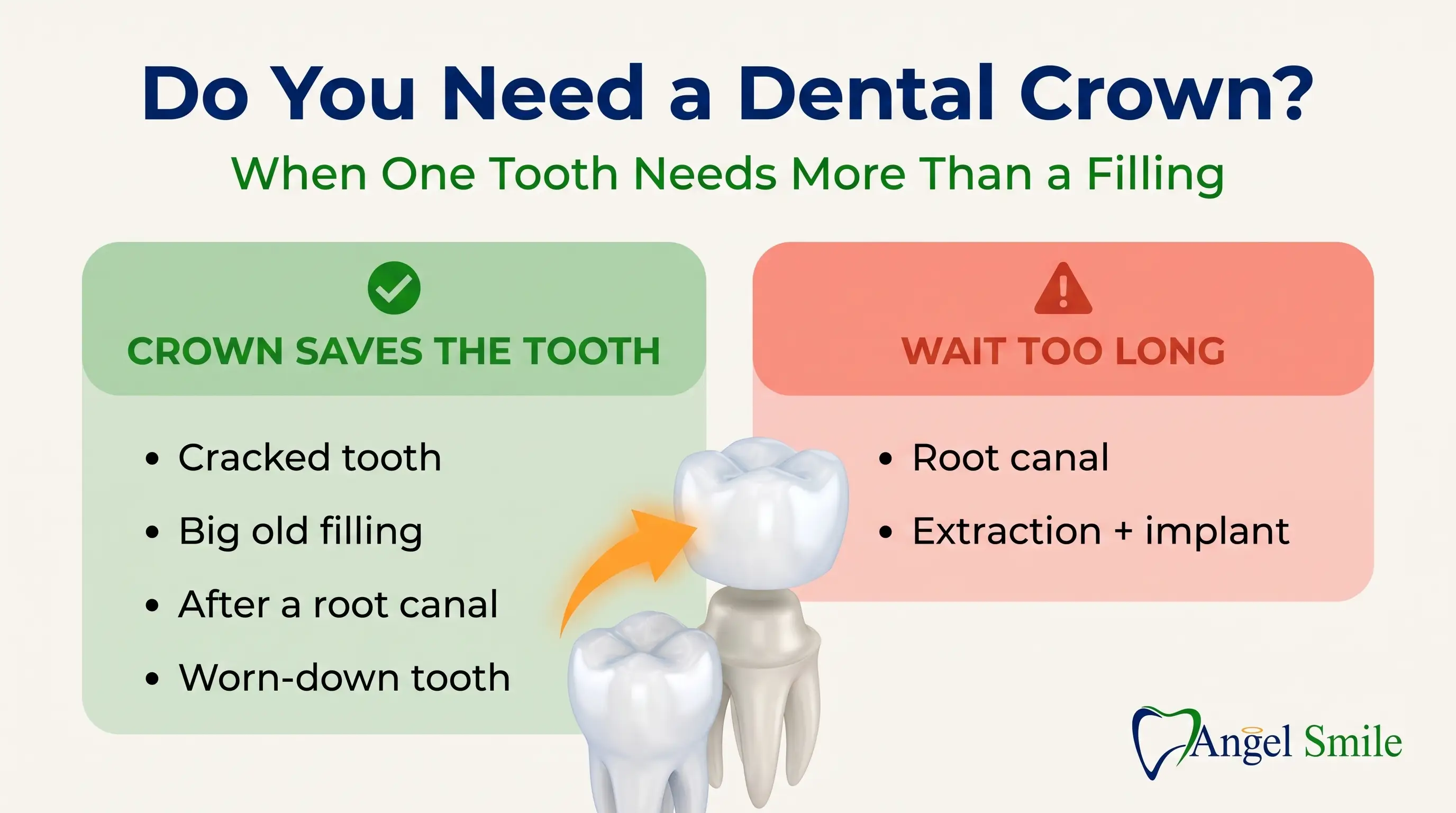
Cracked a molar on a popcorn kernel? Just been told an old filling is too big to hold? You are probably wondering when do you need a dental crown, and whether yours can wait a while longer. Here is the short answer: you need a dental crown when a tooth is too damaged, decayed, or weak to survive on its own, and a filling alone would not hold it together. A crown caps the whole tooth, spreads your bite force across the surface, and keeps a fragile tooth from splitting apart. That protection matters more than most people expect. The CDC's 2024 Oral Health Surveillance Report found that nearly 21% of adults aged 20 to 64 have one or more teeth with untreated decay, and the average adult already carries about six filled teeth. Many of those large old fillings are the exact teeth that end up needing a crown later. This guide walks you through the real warning signs, what crowns are made of, how they differ from a filling, and what a crown visit actually looks like here in Chatsworth.
A dental crown is a custom-made cap that fits over a whole tooth, from the gumline up. Think of it like a helmet for a tooth that can no longer protect itself. Your dentist shapes down the damaged tooth, takes a scan or impression, and then bonds a crown over it that looks and works like a natural tooth.
A filling replaces a small piece of a tooth. A crown covers the entire chewing surface and the walls of the tooth, which is why it can hold a weak tooth together when a filling cannot. Crowns are used on front teeth and back teeth, on natural teeth, on teeth that have had a root canal, and on top of dental implants.
They are common for a reason. Crowns are one of the most-placed restorations in general dentistry, and the materials have gotten stronger and more natural-looking over the past decade.
So when do you need a dental crown instead of a simpler fix? A few clear situations come up again and again in our chairs. Here are the most common ones:
One sign people miss: pain when you release a bite, not when you press down. That rebound pain often points to a cracked tooth, which frequently needs a crown before it breaks all the way. A tooth that breaks suddenly or throbs can be a dental emergency, so do not sit on it.
Pro tip: If a tooth is sensitive to chewing but a filling was done years ago, do not wait for it to break in half. A cracked tooth caught early can often be saved with a crown. Wait too long and the same tooth may need a root canal, or worse, an extraction and a much pricier replacement.
Crowns come in a few materials, and the right one depends on which tooth it is going on, how hard you chew, and how much you care about a seamless match. Here is a plain-language rundown:
Porcelain and ceramic (all-ceramic):
Zirconia:
Porcelain fused to metal:
Gold and metal alloys:
How long do they hold up? A large research review published in the journal Dental Materials estimated that metal-ceramic single crowns have about a 94.7% survival rate at five years, and modern ceramics like lithium-disilicate came in around 96.6%. That is why dentists talk about crowns lasting many years, not months, when you care for them well and keep the gumline healthy so it does not bleed when you brush.
This is the question most patients really want answered, and it comes down to how much healthy tooth is left. A filling works when the damage is small and the surrounding tooth is strong enough to support it. A crown steps in when the tooth needs to be held together, not just patched.
A rough rule we use: if the damage or old filling takes up less than about a third of the tooth, a filling is usually fine. Once it passes half, the tooth walls get too thin to trust, and a crown becomes the safer call. Between those points, your dentist weighs the crack pattern, your bite, and whether the tooth has had a root canal.
Front teeth and molars get judged differently too. Molars take the hardest chewing load, so they crack sooner when weakened. That is why a back tooth with a big filling often gets crowned earlier than a front tooth with the same amount of damage. For a chipped but structurally sound front tooth, your dentist might suggest porcelain veneers or bonding instead of a crown. When we walk a patient through this at their first visit, we show them the tooth on the screen so the choice makes sense, not just a recommendation to trust on faith.
A crown usually takes one or two visits. At the first, which works much like your first visit with us, your dentist numbs the area, shapes the tooth, and takes a digital scan or impression. You leave with a temporary crown while a lab builds the final one. At the second visit, the temporary comes off and the permanent crown is bonded in place and adjusted so your bite feels natural. Some offices with in-house milling can do it in a single day.
Here is a real pattern we see. A Porter Ranch dad came in with a molar that had a filling from his college years and had started aching when he chewed on that side. The tooth had a hairline crack under the old filling. A crown at that stage ran a few hundred dollars out of pocket after insurance. Had he waited until it split below the gumline, the same tooth would have needed a root canal and crown, or an extraction plus an implant, which can climb past several thousand dollars. Catching it early kept both his tooth and his budget intact.
The visit itself is far gentler than most people fear. You are numb the whole time, and the shaping step is quick. If you already deal with dental anxiety, tell the team ahead of time so they can pace the appointment and keep you comfortable. If the tooth is aching right now, here is how to manage dental pain until your appointment.
Cost depends on the material, your insurance, and whether the tooth also needs a root canal or buildup first. Most dental plans cover a good share of a crown when it is needed to restore a broken or decayed tooth, and our front desk can check your benefits before anything starts so there are no surprises.
It depends on how much solid tooth is left. Small chips and cavities usually take a filling. A tooth that is cracked, heavily decayed, worn down, or has had a root canal often needs a crown to hold it together. Your dentist can tell you which after an exam and an X-ray, and can show you the tooth on a screen so you see why.
The procedure itself should not hurt because the tooth and gum are numbed the entire time. You may feel mild sensitivity or tenderness for a few days afterward, which usually settles on its own. If a tooth was already infected, a root canal may be done first to clear the pain at its source.
Most crowns last many years with good care, and research puts five-year survival for common types in the mid-90s percent range. Brushing twice a day, flossing around the crown, avoiding chewing ice or hard candy, and wearing a night guard if you grind all help a crown last longer.
Cost varies by the material and by your insurance coverage. Many dental plans pay a meaningful portion when a crown is medically needed to restore a damaged tooth, which lowers what you pay out of pocket. The best way to get a real number is a quick benefits check before treatment, which our team is happy to run for you.
Yes. The crown itself will not decay, but the natural tooth underneath it can, especially right at the gumline where the crown meets the tooth. That is why regular cleanings and daily flossing around the crown still matter after the tooth is capped, and why sore or bleeding gums around a crowned tooth are worth a look.
Knowing when do you need a dental crown comes down to one idea: a crown saves a tooth that a filling can no longer protect. A crack, a big worn-out filling, a root canal, or deep decay are all signals that a tooth needs more than a patch. Act while the tooth is still there to save, and you keep your natural bite and spend far less than you would replacing it. If a tooth feels sensitive to chewing or you have an old filling that keeps chipping, the smart move is a quick look before it breaks. Our Chatsworth team will show you exactly what is going on and lay out your options with no pressure. Book a Free Consultation and let us help you protect your smile.


