
Mon - Fri: 8:30am - 5:30pm, closed Wednesday

21902 W. Devonshire St, CA 91311


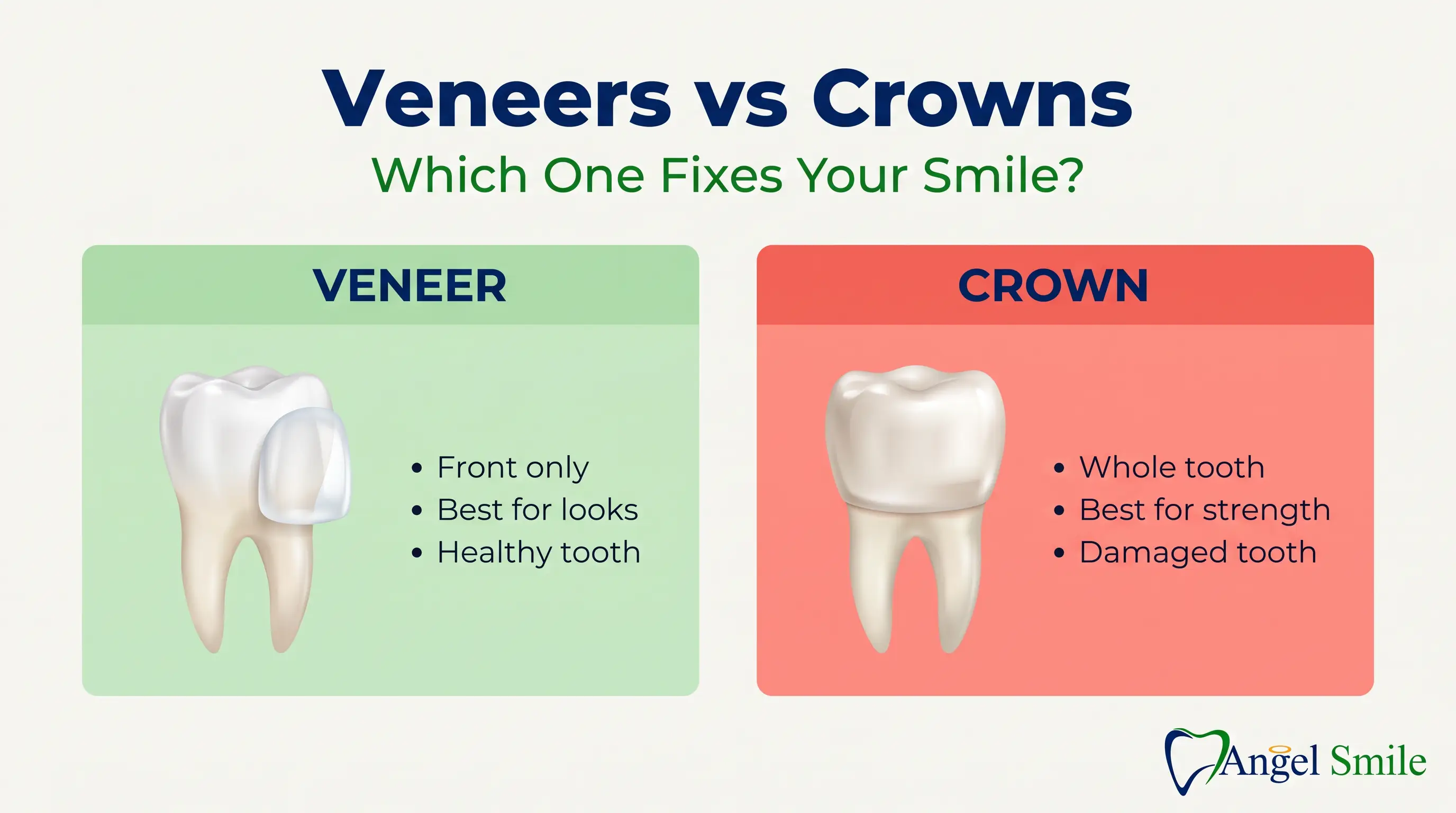
Here is the short answer to veneers vs crowns. A veneer is a thin shell of porcelain that covers only the front of a tooth to make it look better. A crown is a cap that covers the whole tooth to make it stronger. So veneers are mostly about looks, and crowns are about looks plus strength. Choose a veneer when a healthy tooth just looks chipped, stained, or a little crooked. Choose a crown when the tooth is cracked, heavily filled, weak, or has had a root canal. That one difference, front-only versus whole-tooth, drives almost every other choice you will make.
We see this decision play out every week with families across Chatsworth, Canoga Park, and the wider San Fernando Valley. Two people can want the exact same result, a brighter and more even smile, and still need two different treatments, because what is happening underneath the tooth is different. This guide walks you through both options in plain language, with real costs, real lifespans, and a simple way to know which one fits your smile.
Think of your tooth like a piece of furniture. A veneer is like a fresh coat of paint and a new front panel. A crown is like reinforcing the whole frame and then refinishing it. Both make things look great, but only one adds real structural strength.
A veneer is bonded to the front surface of a tooth. Your dentist removes a very thin layer of enamel, often less than a millimeter, then cements a custom porcelain shell over the front. The back and sides of your natural tooth stay untouched. This is why veneers work best on teeth that are already healthy and strong and just need a cosmetic upgrade. If you want a fuller look at how veneers compare to a lighter cosmetic fix, our guide on veneers versus bonding breaks that down.
A crown is different. Your dentist reshapes the entire tooth on all sides, removing more structure, then fits a cap that covers everything down to the gumline. Because the crown wraps the whole tooth, it holds a weak or broken tooth together and takes the pressure of chewing. That is why crowns are the go-to fix after big cracks, large old fillings, or a root canal. If you are not sure whether your tooth needs that level of protection, our post on when you need a dental crown covers the warning signs.
Coverage and tooth removal, side by side:
A veneer shines when the tooth is basically sound and the problem is cosmetic. You have a healthy tooth, but it is not the shade, shape, or spacing you want. Porcelain fixes that without changing the whole tooth.
Veneers are a strong fit when you deal with any of these:
Here is a real example. A Northridge teacher came in unhappy with a chipped and slightly gray front tooth that no amount of professional teeth whitening could fix. The tooth itself was strong, with no decay and no big fillings. She got two porcelain veneers, one on each front tooth, so they would match. The result looked natural, and she kept nearly all of her real tooth. That is the classic veneer case: healthy tooth, cosmetic goal.
Does research back up how long they last? Yes. A systematic review of clinical studies found that porcelain veneers had roughly a 96 percent survival rate at 5 years and about 93 percent at 10 years, with many lasting far longer when cared for well. That is a strong track record for a treatment that keeps most of your natural tooth.
Pro tip: Before you commit to veneers, ask your dentist for a wax-up or a digital preview of your new smile. You get to see the shape and length before any enamel is touched. It is the easiest way to avoid surprises, and it costs you nothing but a little time.
One thing to know upfront: veneers do remove a thin layer of enamel, and enamel does not grow back. So a veneer is a permanent commitment for that tooth. That is not a reason to avoid it, but it is a reason to be sure. If your teeth already feel touchy to cold or sweet, read our guide on tooth sensitivity and mention it at your consult, because it can affect the plan.
A crown is the answer when the tooth needs protection, not just polish. If a tooth is cracked, broken, worn down, or hollowed out by a large filling, a veneer on the front will not hold it together. The tooth needs full coverage so it does not split under the force of chewing.
You most likely need a crown, not a veneer, when the tooth has any of these:
Picture a common Chatsworth case. A patient cracked a back molar biting into a hard candy, and the crack ran deep enough to reach the nerve. He needed a root canal to save the tooth, and then a crown to protect it. A veneer was never an option there, because the whole tooth was compromised, not just the front of it. The crown let him keep his own tooth instead of losing it.
Crowns hold up well over time too. Research on single crowns has reported survival rates near 95 percent at 5 years, with modern all-ceramic and porcelain crowns performing on par with older metal-based ones. So a crown is not a short-term patch. It is a long-term repair that can carry a tooth for a decade or more.
Crowns also matter for the health of your whole mouth, not just one tooth. A cracked tooth left open invites decay and infection, and the cost of ignoring it climbs fast. That is the same money math we cover in our post on how smart patients save money by fixing small problems before they turn into big ones.
Cost is usually the next question, and the honest answer is that veneers and crowns land in a similar range per tooth, but they are paid for very differently. A veneer is almost always cosmetic, so insurance rarely helps. A crown is usually medically needed, so insurance often covers a good share of it.
What each one typically costs and covers:
Lifespan is close between the two. Both porcelain veneers and crowns commonly last 10 to 15 years or more, and both can fail early if you grind your teeth, chew ice, or skip cleanings. A night guard protects either one if you clench at night. Daily care is simple and the same for both: brush twice a day, floss once, and keep your regular checkups so we catch a chip or a loose edge early. Our guide on caring for your new smile has the full routine.
What we have seen working with patients across the Valley is that the right choice almost never comes down to price alone. It comes down to what the tooth needs. A healthy tooth with a cosmetic flaw does great with a veneer. A weak or damaged tooth needs the full protection of a crown. When you match the treatment to the tooth, both the look and the lifespan take care of themselves. If you want a broader look at your restorative options for a badly damaged or missing tooth, our comparison of bridges, dentures, and implants covers what comes next.
For a healthy front tooth with a cosmetic issue, a veneer is usually the better pick because it keeps more of your natural tooth and looks very natural. A crown is the better choice for a front tooth that is cracked, heavily filled, or has had a root canal, since it needs full coverage to stay strong. Your dentist will look at how much healthy tooth is left to make the call.
They last about the same. Both porcelain veneers and crowns commonly last 10 to 15 years or more with good care. Grinding, chewing hard objects, and skipping cleanings are the main reasons either one fails early. A night guard and regular checkups help both last as long as possible.
Neither should hurt during the visit, because the tooth is numbed first. A crown involves a bit more tooth reshaping, so you may notice mild soreness or cold sensitivity for a few days after. Veneers usually cause less of that since less tooth is touched. Over-the-counter pain relief is enough for most people.
Yes. If a tooth with a veneer later cracks, decays, or needs a root canal, a crown can replace the veneer and cover the whole tooth. It does not work the other way around as easily, since a crown removes more tooth structure than a veneer. That is one reason we start with the most conservative option that will actually solve the problem.
Most plans do not cover veneers, because they are considered cosmetic. Crowns are a different story, since they are usually needed to protect a damaged tooth, so many plans cover roughly half after your deductible. Bring your plan details to your consultation and we will give you a clear estimate before anything is scheduled.
The whole veneers vs crowns question really comes down to one honest look at your tooth. If the tooth is healthy and you just want it to look better, a veneer keeps more of your natural tooth and gives you a beautiful result. If the tooth is cracked, weak, or already treated, a crown gives it the strength to last. Match the fix to the tooth, and you get a smile that looks great and holds up for years.
You do not have to figure this out alone. At Angel Smile Dental Group, we look at the tooth, talk through your goals and your budget in plain language, and give you a straight recommendation, not a hard sell. New to us? Our guide to dental veneers in Chatsworth is a good place to start.
Book a Free Consultation and we will help you choose the right option for your smile with no pressure and no guesswork.


