
Mon - Fri: 8:30am - 5:30pm, closed Wednesday

21902 W. Devonshire St, CA 91311


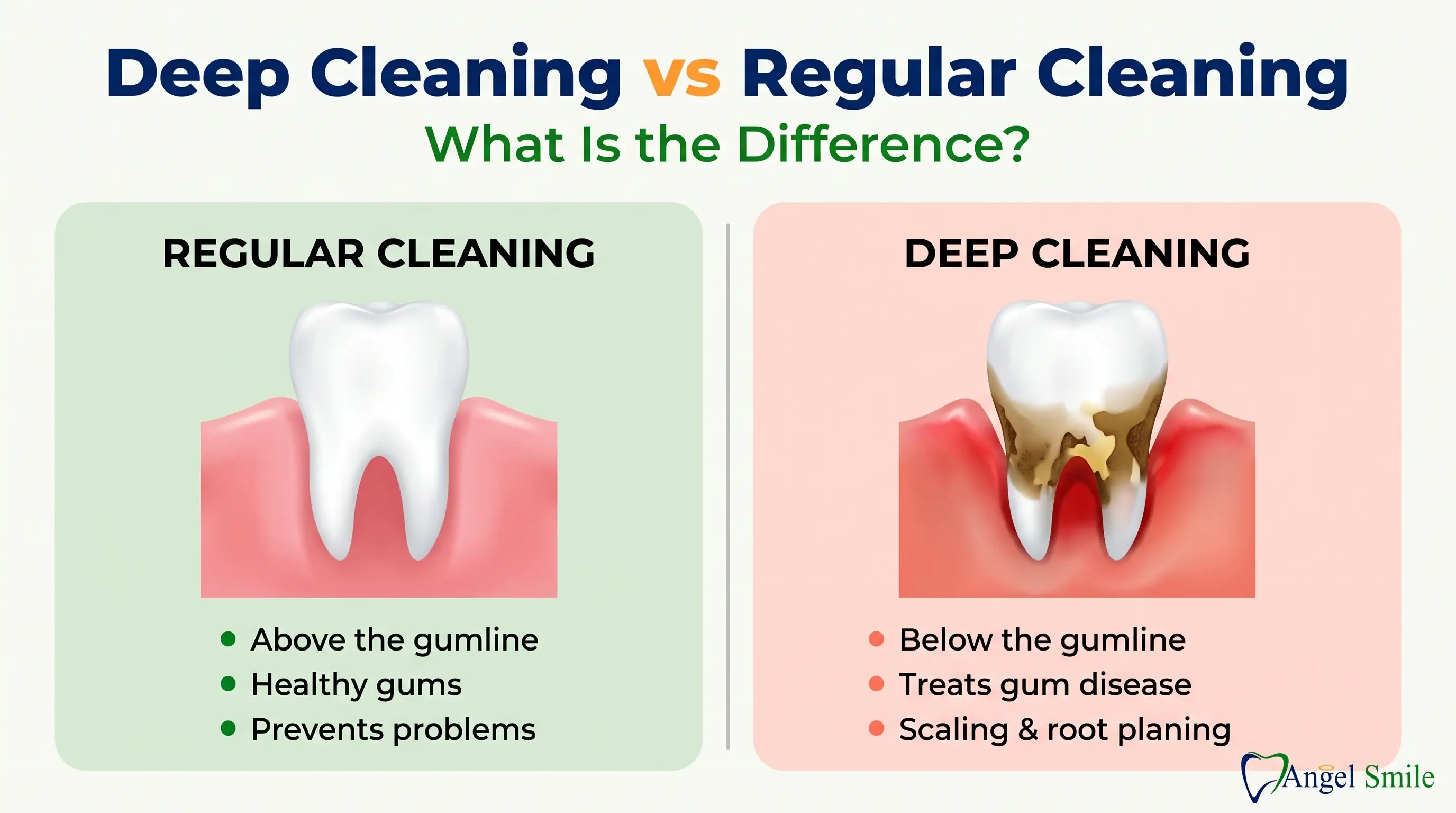
Here is the short answer: a regular cleaning and a deep cleaning are two different procedures for two different situations, so deep cleaning vs regular cleaning really comes down to how healthy your gums are. A regular cleaning keeps healthy gums healthy by clearing plaque and tartar at and just above the gumline. A deep cleaning treats gum disease by going below the gumline to remove buildup off the tooth roots. This matters more than most people think, because gum disease is common and quiet. The CDC reports that about 42% of adults aged 30 and older have periodontitis, a serious gum infection, and roughly 8% have a severe case.
At Angel Smile Dental Group, we hear the same worry all the time from families across Chatsworth, Canoga Park, and Northridge: "My dentist says I need a deep cleaning, but is that just an upsell?" Almost always, it is not. Let's walk through what each cleaning does, how to tell which one you actually need, what each one costs, and how to never need the deep version again.
The difference between a deep cleaning vs regular cleaning is depth and purpose. A regular cleaning is preventive and works on the visible part of your teeth and the shallow space where the gum meets the tooth. A deep cleaning is a treatment for active gum disease and reaches down into the pockets that form when gums pull away from the teeth. One protects a healthy mouth. The other repairs a mouth that has already slipped into trouble.
Think of it like the gap between a regular oil change and repairing an engine that has started to knock. Both matter, but you only need the repair once real damage has set in.
A regular cleaning (called a prophylaxis) is for you if your gums are healthy. It usually covers:
A deep cleaning (called scaling and root planing) is for you if you have gum disease. It usually covers:
The word "pocket" is the key. When plaque and tartar sit under the gum long enough, the gum detaches and forms a little pocket that traps more bacteria. A regular cleaning cannot reach the bottom of a deep pocket. A deep cleaning can, which is the whole reason the two procedures exist.
Your dentist decides between a deep cleaning vs regular cleaning by measuring your gum pockets with a small probe and looking at your gums on an X ray. Healthy pockets measure about 1 to 3 millimeters. Once pockets reach 4 millimeters or more, or your gums bleed and pull back, a regular cleaning is no longer enough and a deep cleaning becomes the right call.
You are probably fine with a regular cleaning if:
You likely need a deep cleaning if:
Bleeding is the sign people wave off the most, and it is usually the first real warning. If your gums bleed when you brush, it is worth understanding why your gums bleed when you brush before the problem digs in deeper.
Soreness and swelling alongside the bleeding are another reason to book. Our guide on sore or bleeding gums and when to see a dentist can help you decide whether to come in now or at your next visit.
Pro tip: Ask to see your pocket numbers. A trustworthy office will read them out loud, and healthy readings are 1 to 3 millimeters. If you hear 4, 5, or 6, that is the honest reason a deep cleaning is on the table, not a sales pitch. Knowing your numbers turns the whole decision from a mystery into simple math.
Knowing the steps takes the nerves out of either visit. A regular cleaning is quick, gentle, and usually done in one appointment. A deep cleaning takes longer and is often split into two visits so each side of your mouth can heal.
A regular cleaning usually goes like this:
A deep cleaning usually goes like this:
After a deep cleaning your gums may feel tender for a few days and your teeth can feel sensitive to cold for a little while. That sensitivity is normal and usually fades. If cold or sweet already bothers you, our post on why your teeth feel sensitive explains what causes it and what helps.
Cost is where the deep cleaning vs regular cleaning gap really shows up, and it is the strongest argument for staying ahead of gum disease. A routine cleaning is cheap or free with insurance. A deep cleaning is a multi part treatment that costs far more, and gum care after it never fully stops.
Here is the rough money picture:
The pattern is clear. Two affordable cleanings a year cost a fraction of one deep cleaning plus the ongoing maintenance that follows it. That is the case for prevention in a single sentence, and it is why our approach to preventive dentistry leans so hard on keeping small problems small.
Here is a real example from our chair. A patient in his 30s from Canoga Park skipped cleanings for a few years because he felt fine and money was tight. By the time he came in, several pockets measured 5 millimeters and his gums bled at the lightest touch. He needed a full deep cleaning that ran well over $1,000, plus maintenance visits after that. Had he kept up standard cleanings at around $150 each, he would have spent far less and kept his gums healthy the whole time. What we have seen with families across the Valley is that the cost of waiting is almost always higher than the cost of showing up.
Money should never be the reason you skip care, and it usually does not have to be. If you are unsure what your plan pays for, our plain guide to using your dental insurance benefits shows you how to get the two covered cleanings most plans already include.
The best outcome is never needing the deep version at all, and that is mostly in your hands. Gum disease is largely preventable, and the CDC points to poor oral hygiene, diabetes, and smoking as the main drivers of the serious kind. Control those and you tilt the odds hard in your favor.
A few habits do most of the work:
Staying on a schedule is the quiet key. If you are not sure how often that should be, our guide on how often you should get a dental cleaning breaks it down by age and risk.
Good technique matters too. A strong daily oral hygiene routine between visits is what keeps most people in the regular cleaning lane for life.
The diabetes link deserves a special note for our community. Our post on diabetes and gum disease covers that two way street in plain language, since high blood sugar and gum trouble feed each other.
When a deep cleaning is recommended because your pockets measure 4 millimeters or more, it is a real treatment for active gum disease, not an upsell. The way to be sure is to ask for your pocket numbers. Healthy gums measure 1 to 3 millimeters, so anything deeper is the honest reason behind the recommendation. If you ever feel unsure, a second opinion is always fair.
A regular cleaning cannot reach the tartar sitting below the gumline in deep pockets, so it will not treat gum disease. Choosing the regular version when you need the deep one lets the infection keep spreading, which can lead to bone loss and loose teeth. Your dentist recommends the deep cleaning because it is the only one that reaches the problem.
Your dentist numbs the area first, so the procedure itself is comfortable for most people. Afterward your gums may feel sore and your teeth a bit sensitive to cold for a few days, which usually fades quickly. Over the counter pain relief and warm salt water rinses help while your gums heal.
A deep cleaning is usually split into two visits, each about an hour, so one side of your mouth is treated at a time. Splitting it keeps you comfortable and gives each side a chance to heal. A regular cleaning, by contrast, is typically done in a single 30 to 60 minute visit.
Most patients move to periodontal maintenance cleanings every three or four months after a deep cleaning, rather than the usual twice a year. More frequent visits keep the pockets from filling back up while your gums recover. Once your gums are stable, your dentist may stretch the interval back out.
The deep cleaning vs regular cleaning question always comes back to the health of your gums. Healthy gums need a regular cleaning to stay that way. Gums with disease need a deep cleaning to heal. The good news is that catching trouble early, at the bleeding stage rather than the loose tooth stage, keeps most people in the simple, affordable regular cleaning for life. A quick visit now beats a big treatment later, every single time.
Not sure which cleaning you actually need? Let our team measure your gums and give you a straight answer. Book a Free Consultation with Angel Smile Dental Group and get a clear, honest plan for your smile, your family, and your budget.


